
Table of Contents
- What Makes a Custom Acrylic Lamp Durable
- Acrylic vs Glass Lamp Durability: Which Survives Real Life
- Does Acrylic Yellow With LED Lights?
- How to Clean Acrylic LED Lamps Without Scratching Them
- How Long Do Custom Acrylic Lamps Last?
- Choosing a Durable Custom Acrylic Lamp
- Frequently Asked Questions
Last Updated: September 11, 2026
What Makes a Custom Acrylic Lamp Durable
Ask whether custom acrylic lamps are durable and the honest answer is yes, provided the material is specified correctly. Acrylic is a thermoplastic prized for impact strength, optical clarity and shatter resistance, and a well-made acrylic lamp body will typically outlast the electronics inside it. At IL-ĦSIEB KOLLOX, we laser-engrave designs onto 4mm clear acrylic, a thickness that resists flexing while still diffusing light evenly.
Durability in an acrylic lamp comes down to three things: how the sheet handles impact, how it holds its finish, and how it copes with heat from the LED module. Get those right and the lamp survives drops, dusting and daily use for years.
The rest of this guide breaks down each factor, compares acrylic against glass, and covers the maintenance that keeps a lamp looking new.
Impact Strength and Shatter Resistance
Impact strength is where acrylic leaves glass behind. A 4mm acrylic sheet flexes under force rather than fracturing, so a knock from a vacuum cleaner or a child's toy bends the panel instead of shattering it. Glass in the same situation cracks and leaves sharp edges. That difference matters most in high-traffic rooms, kids' bedrooms and play rooms where lamps get brushed against regularly. Acrylic is a shatter-resistant thermoplastic, though it is not unbreakable: a sharp, concentrated strike can still crack it. For a lamp that sits on a table or shelf, that risk is minimal.
Material Density, Gloss Finish and Optical Clarity
Material density and surface finish decide how a lamp looks on day one and in year five. Acrylic has roughly half the density of glass, which keeps a large lamp light enough to move with one hand. Its light transmission sits close to glass, so colours stay bright and edges glow cleanly. A gloss finish gives the crisp, polished look buyers expect from a personalised gift. The trade-off is that gloss surfaces show fingerprints and fine scratches more readily than matte ones, which is why the cleaning method in a later section matters so much.
Acrylic vs Glass Lamp Durability: Which Survives Real Life
Acrylic wins on durability for everyday home lighting, but the reasons go deeper than the usual "it doesn't shatter" line. Acrylic is a polymer chain of methyl methacrylate units, and that molecular structure absorbs impact by flexing and recovering rather than cracking. Glass is a brittle amorphous solid: it has no mechanism for stress relief, so a single sharp blow propagates a crack through the entire panel. That difference explains why a 4mm acrylic sheet can survive a knock from a vacuum cleaner or a dropped toy, while a 4mm glass panel of the same size would likely shatter into sharp shards.
Weight matters too. Acrylic has a density of roughly 1.18 g/cm³, compared with about 2.5 g/cm³ for standard soda-lime glass. A large acrylic lamp weighs less than half its glass equivalent, which makes it safer to move, less likely to topple, and easier to mount on a wall or shelf. For a lamp that will be handled, gifted, or placed in a child's room, that weight difference is a genuine durability advantage.
Where glass still wins is scratch resistance. Glass has a Mohs hardness of around 5.5, while acrylic sits closer to 2-3. That means glass resists fine surface scratches better over decades of dusting. But acrylic has a counter-advantage: light scratches can be polished out at home, whereas scratched glass is permanently damaged. This is the trade-off most buyers miss, glass stays clearer longer if untouched, but acrylic can be restored to clarity, which extends its practical lifespan.
| Factor | Acrylic | Glass |
|---|---|---|
| Impact resistance | Flexes and recovers; resists shattering | Brittle; cracks and shatters |
| Density | ~1.18 g/cm³ (light) | ~2.5 g/cm³ (heavy) |
| Mohs hardness | 2-3 (scratches more easily) | ~5.5 (scratches less easily) |
| Scratch repair | Can be polished out | Permanent damage |
| UV yellowing | UV-stable grades resist yellowing; standard grades may discolour in direct sun | Does not yellow |
| Custom fabrication | Easy to cut, engrave, and thermoform | Limited; brittle when thin |
| Breakage safety | No sharp shards | Sharp edges when broken |
| Recyclability | Recyclable (code 7 - other), but limited infrastructure | Infinitely recyclable |
| Best for | Kids' rooms, gifts, high-traffic areas, handled lamps | Static display, low contact, scratch-critical surfaces |
The practical read: choose acrylic where the lamp will be touched, moved, or lived around. Choose glass only where it will sit untouched and scratch resistance outweighs breakage risk. For custom lamps with engraved designs, acrylic is the only practical choice, glass is too brittle for fine laser engraving at thin thicknesses.
UV Degradation and Yellowing: The Chemistry Competitors Skip
Most guides say acrylic "may yellow over time" without explaining why. The mechanism is photo-oxidation. When acrylic is exposed to UV light, particularly the UV-A and UV-B bands in direct sunlight, the polymer chains can break and form new chemical groups called chromophores. These chromophores absorb blue light, which makes the material appear yellow. The process is accelerated by heat and by certain manufacturing impurities.
The good news is that LED lamps emit almost no UV. A standard white LED produces light in the visible spectrum with only trace UV output, so the yellowing risk from the light source itself is negligible. The real risk is environmental: a lamp left in a south-facing window for years will receive enough UV to trigger gradual discolouration. Standard acrylic is UV-stable enough for indoor use, but if you want maximum longevity, look for acrylic that includes UV stabilisers or a UV-filtering coating. These additives absorb UV energy before it can break polymer chains, extending clarity for many years beyond standard grades.
Environmental Impact and Recyclability
Acrylic is recyclable, it carries resin identification code 7 (other), and it can be mechanically recycled into new sheets or pellets. However, the infrastructure for acrylic recycling is less widespread than for glass or PET, so in practice many acrylic lamps end up in general waste. Glass, by contrast, is infinitely recyclable with well-established collection systems. If sustainability is a priority, glass has the edge on end-of-life processing. But acrylic's lighter weight means lower transport emissions, and its durability means a well-made lamp stays out of the waste stream for many years. The most sustainable choice is the one you keep longest, and for handled, custom lamps, that is usually acrylic.
Does Acrylic Yellow With LED Lights?
Acrylic does not yellow under LED light the way it can under older halogen or fluorescent sources. LEDs emit very little UV, and UV exposure is the main driver of yellowing in plastics. Standard acrylic is UV-stable enough for indoor lamp use, so colour retention holds up well over a normal service life. The caveat is direct sunlight: a lamp left in a bright, south-facing window for years may show gradual discolouration. Keep it out of constant direct sun and the acrylic will stay clear.
Heat Tolerance and LED Heat Dissipation: The Thresholds That Matter
Heat is the factor most buyers overlook, and most guides never give you the numbers. Acrylic has a glass transition temperature (Tg) of around 105°C for standard grades, but it begins to soften and deform at much lower temperatures under load. The practical working limit for continuous exposure is typically cited as 60-80°C, depending on the specific grade and thickness. Above that range, the material can warp, craze (develop fine internal cracks), or lose optical clarity. These changes are permanent.
This is why LED heat dissipation matters so much. LEDs convert most energy to light rather than heat, but they still produce waste heat at the back of the module. A poorly designed lamp with a hot LED pressed directly against the acrylic panel can push local temperatures past the safe threshold, especially if there is no air gap. Over months of daily use, that heat can cause the panel to bow or develop a hazy patch above the light source.
A well-designed acrylic lamp solves this in three ways:
- Cool-running LEDs. Modern LED modules for decorative lamps typically operate at surface temperatures well below 60°C, often in the 30-50°C range, which is safely within acrylic's tolerance.
- Air gap. Leaving a few millimetres of space between the LED module and the acrylic sheet allows heat to dissipate into the air rather than conducting directly into the plastic.
- Heat sinks or ventilation. Some designs use a small aluminium heat sink or discreet vents to draw heat away from the panel.
When you are evaluating a custom acrylic lamp, ask the maker what the LED operating temperature is and whether there is an air gap. A lamp that runs cool to the touch after an hour of use is a lamp that will not warp its acrylic.
Thermal Expansion and Long-Term Stability
Acrylic expands and contracts with temperature changes more than glass does. Its coefficient of linear thermal expansion is roughly 70 × 10⁻⁶ per °C, compared with about 9 × 10⁻⁶ per °C for glass. In a lamp, that means the acrylic panel will grow and shrink slightly as the lamp heats and cools. Good design accounts for this by not clamping the panel rigidly at multiple points, instead, the panel should be held in a way that allows slight movement. If a lamp is over-constrained, repeated thermal cycling can cause stress cracks at the mounting points over time. This is a subtle failure mode that cheap lamps often suffer from, and it is worth checking that the frame or base allows the acrylic to expand naturally.
How to Clean Acrylic LED Lamps Without Scratching Them
Clean acrylic with a soft microfibre cloth and lukewarm water with a drop of mild soap. Never use paper towels, abrasive sponges or ammonia-based cleaners, all of which dull the gloss finish and leave fine scratches that scatter light.
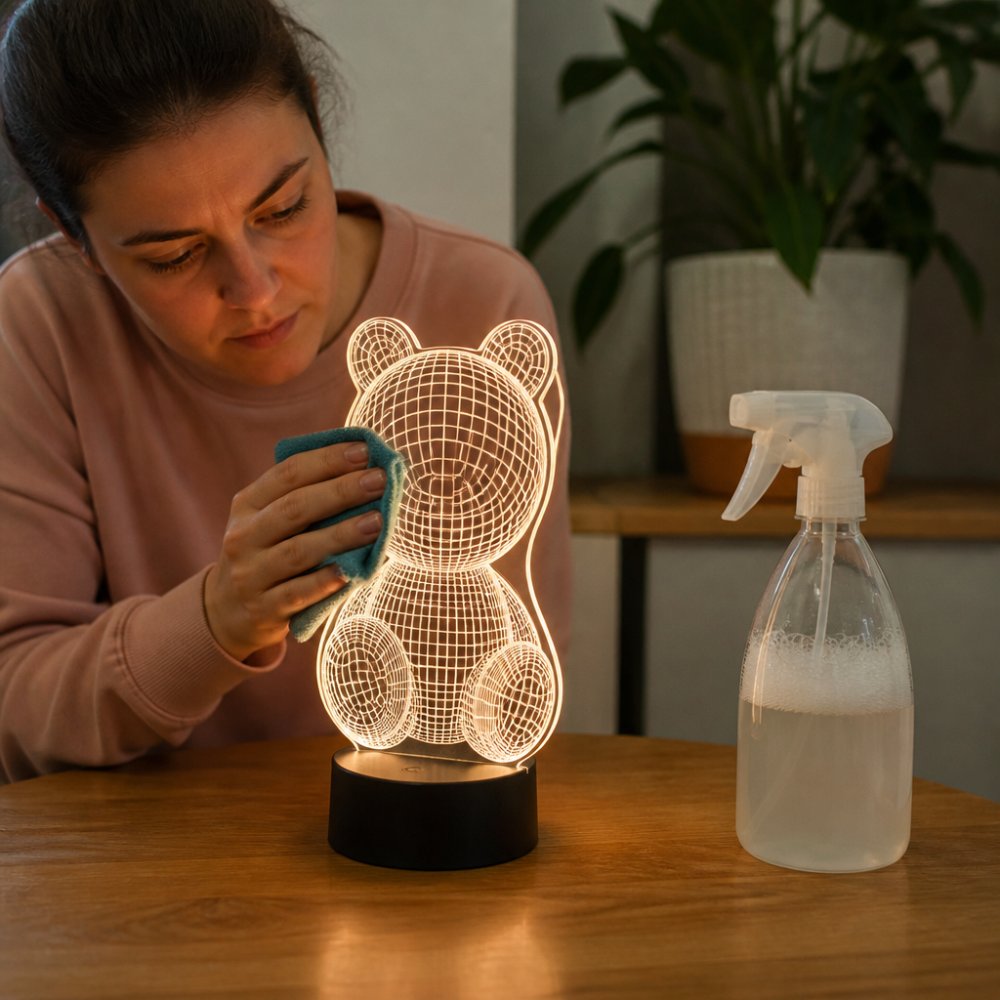
Follow this order:
- Unplug the lamp and let it cool.
- Dust the surface with a dry microfibre cloth first.
- Mix lukewarm water with a small amount of mild soap.
- Wipe gently in straight lines, not circles.
- Rinse the cloth and wipe again with clean water.
- Dry immediately with a dry microfibre cloth to avoid water spots.
Avoid alcohol, acetone and glass cleaners. They attack the surface and strip the gloss.
Scratch Repair and Polishing
Light scratches can be polished out, which is one advantage acrylic holds over glass. Start with a plastic polish and a soft cloth, working in small circles over the mark, then buff clear. Deeper scratches need a graded approach: fine wet-and-dry paper followed by a polishing compound. Most surface scuffs from dusting or storage disappear with a single polish. Deep gouges that catch a fingernail are best left alone or treated by a specialist, since over-sanding flattens the optical clarity of the panel.
How Long Do Custom Acrylic Lamps Last?
A well-made custom acrylic lamp lasts many years, and often outlives the LED module inside it. Acrylic itself does not rot, rust or degrade indoors, so the limiting factors are surface scratches, UV exposure and the electronics. In practice, the LED driver is usually the first component to fail, and it can be replaced without touching the acrylic panel. Keep the lamp out of direct sun, clean it gently, and avoid heat sources, and the acrylic will hold its clarity and colour for the long term. Service life comes down to care, not the material's natural limits.
Choosing a Durable Custom Acrylic Lamp
Choose a lamp built from thick, clear acrylic with a cool-running LED module and a design that does not press the light source against the panel. Thickness matters: a 4mm sheet resists flexing far better than a thin, flimsy one. Ask how the design is applied, since laser engraving into the acrylic holds up better than a surface sticker that peels. And check the light source runs cool, because heat is the one thing that genuinely shortens an acrylic lamp's life.
That is exactly how we build ours. Our Spotify Code Acrylic 3D LED Lamp and other 3D lamps use 4mm clear acrylic with laser-engraved designs and LEDs that never get hot, so the panel stays clear and the colours stay true. Each lamp lets you change colours with a touch button and add your own name, text or date, turning a durable object into a personal keepsake.

Frequently Asked Questions
What are the downsides of acrylic plastic?
Acrylic scratches more easily than glass, so abrasive cloths and harsh cleaning agents will dull the gloss finish over time. It also expands and contracts with temperature changes, and prolonged direct sunlight can cause yellowing. None of these make acrylic lamps a bad choice, but they explain why gentle cleaning and sensible placement matter. Keeping a lamp away from radiators and using a microfibre cloth will protect the surface for years.
Is acrylic shatterproof compared to traditional glass lamps?
Acrylic is far more shatter-resistant than glass. Where a glass shade can crack into sharp pieces from a knock or a fall, an acrylic sheet flexes and absorbs the impact instead. That impact strength is why acrylic is common in children's rooms and high-traffic areas. It is not unbreakable, but for a lamp that sits on a bedside table or a shelf, the difference in safety is significant.
How do you clean a custom acrylic LED lamp without scratching it?
Switch the lamp off, then wipe the surface with a soft microfibre cloth and lukewarm water with a drop of mild washing-up liquid. Never use paper towels, scouring pads or cleaners containing ammonia or alcohol, as these cause fine scratches and clouding. For fingerprints, breathe on the acrylic and buff gently. Dry with a second clean cloth to avoid water marks on the gloss finish.
Does acrylic yellow over time when used with LED lights?
LED lights themselves do not cause yellowing because they produce very little UV and almost no heat at the acrylic surface. Yellowing comes from prolonged exposure to sunlight and from cheap acrylic with poor UV stability. A quality laser-engraved acrylic lamp kept out of direct sun should hold its optical clarity and colour retention for many years, which is why UV stability is worth checking before you buy.
Acrylic lamps are durable, but only as durable as the materials and care behind them. If you want a personalised lamp built to last, IL-ĦSIEB KOLLOX offers 3D acrylic LED lamps with laser-engraved designs, touch colour control and custom text, all made from 4mm clear acrylic that resists everyday knocks. Get started with IL-ĦSIEB KOLLOX and create a keepsake that stays bright for years.