Table of Contents
- What to Expect From a Custom Pet Photo Crystal
- How to Choose a Photo for 3D Crystal Engraving
- Crystal Shapes and Sizes for Different Pets
- Custom Acrylic LED Lamps for Pets: A Practical Alternative
- Durability, Clarity and Long-Term Care
- How to Verify Quality Before You Buy
- Pricing, Turnaround and Gift Packaging
- Conclusion
- Frequently Asked Questions
Last Updated: September 10, 2026
What to Expect From a Custom Pet Photo Crystal
Pet photo crystals are solid blocks of optical glass with a 3D laser engraving suspended inside, created by focusing a laser through the surface to etch thousands of tiny points beneath the glass. The result is a portrait that appears to float in mid-air, with real depth when you turn it.
This guide covers what separates a good engraving from a disappointing one, how to pick the right photo, and what to check before ordering.
The technology is well established: museums and glass studios have used sub-surface laser etching for years because it produces no surface damage and no fading. What varies between providers is engraving resolution, glass clarity, and image preparation, the three factors that decide whether you get a lifelike tribute or a faint grey smudge.
How to Choose a Photo for 3D Crystal Engraving
Choosing a photo for 3D crystal engraving means picking an image where your pet's head and chest fill most of the frame, the lighting is even, and the background is uncluttered. Portrait-style shots work best because the laser renders depth from the subject's contours, not scenery.
Most guides tell you to send your favourite photo, which is how people end up disappointed. A photo that looks lovely on a phone screen often fails inside glass: the process converts your image into a point cloud, and soft focus becomes mush.
Resolution, Lighting and Background Checklist
Work through this list before you upload anything:
- Resolution: at least 2 megapixels, ideally the original camera file rather than a screenshot
- Lighting: even, diffused light with no harsh shadows across the face or muzzle
- Background: plain or easily removed; avoid busy patterns, other animals, or clutter
- Framing: head and chest filling roughly 70% of the frame
- Expression: eyes open, ears forward, mouth relaxed
- Contrast: dark fur against a light background, or light fur against a dark one
- Colour: colour photos convert well, but high-contrast monochrome can render fur texture more cleanly
A common mistake is submitting a photo taken at night under a phone flash. Flash flattens the face and blows out the shine in a dog's eyes, and the laser cannot recover detail that is not there.
If your only good photo is low resolution, ask whether the provider offers subject enhancement before engraving. Reputable studios will clean up the image, sharpen fur texture, and remove the background. A provider who accepts anything without comment is a warning sign.
Crystal Shapes and Sizes for Different Pets
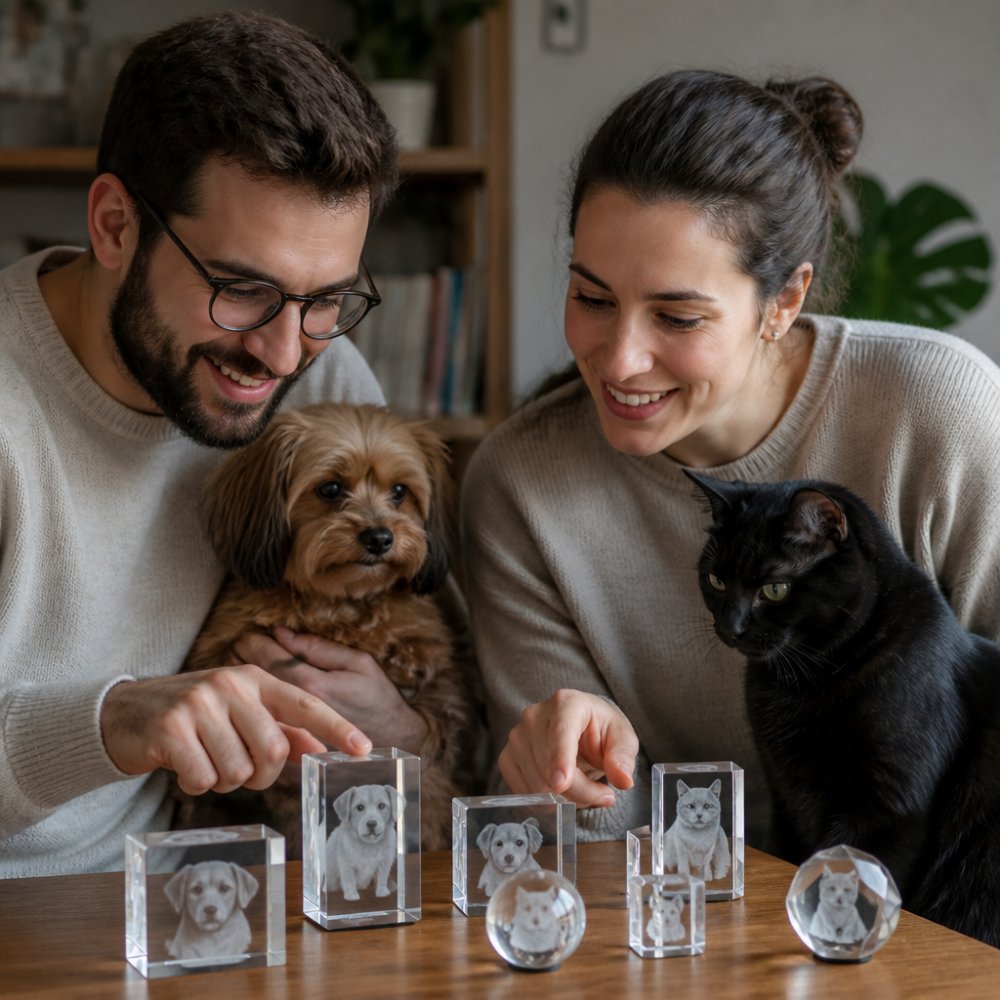
Shape matters more than most buyers expect. A cube or rectangular block suits a seated full-body pose, while a heart or oval flatters a close head-and-shoulders portrait. The skill is matching the shape to your pet's features.
Matching the Shape to the Animal
| Crystal Shape | Best For | Why It Works |
|---|---|---|
| Cube | Large dogs, full-body poses | Deepest block, strongest depth perception; ideal for German Shepherds, Labradors, and other broad-chested breeds |
| Rectangle | Medium dogs, head and chest | Wide face fits the frame without cropping; suits Beagles, Bulldogs, and Boxers |
| Heart | Cats, small dogs, memorial tribute | Compact and suits a close portrait; perfect for Persians, Siamese, and Chihuahuas |
| Oval | Long-snouted breeds | Curved edge follows the muzzle line; excellent for Greyhounds, Dachshunds, and Collies |
| Round | Any pet, shelf display | Even light refraction from every angle; versatile for multi-pet households |
| Tower | Tall, upright poses | Vertical format emphasises sitting or standing posture; good for alert breeds like Dobermans |
For a large breed such as a German Shepherd or Labrador, a cube gives the laser enough depth to render the chest and shoulders convincingly. For a cat or small terrier, a heart or round crystal keeps the portrait tight. For a long-snouted breed like a Greyhound, an oval follows the curve of the muzzle and prevents the nose appearing cut off.
Bigger is not automatically better: a larger block with a small, low-detail photo looks emptier, not more impressive. Match the size to the detail in your image. As a rule of thumb, a 2-megapixel photo can fill a 5cm x 5cm x 8cm block; a 10cm cube needs at least an 8-megapixel original. A portrait occupying about 70% of the crystal's height gives the most balanced result.
Choosing for Multiple Pets
For two or more pets in one crystal, shape becomes even more critical. A wide rectangle or large cube works best because it gives the laser room to separate each animal in depth. Avoid heart or oval shapes for multi-pet portraits, as curved edges crowd the composition. For three or more pets, consider a tower or custom-cut block.
The Technical Reason Shape Affects Clarity
Sub-surface laser engraving creates tiny fracture points inside the glass, and the distance between those points and the surface determines how much light is refracted and how sharp the image appears. A cube or rectangle offers more glass between the engraving and the viewer, enhancing the 3D effect but also amplifying flaws in the photo. A heart or oval has less depth, so it demands a higher-contrast image. Ask the provider which shapes they recommend; a good studio will say honestly if your chosen shape is working against your image.
Custom Acrylic LED Lamps for Pets: A Practical Alternative
A custom acrylic LED lamp for pets is an engraved acrylic panel lit from below by an LED base, making the engraved lines glow against a dark background. It costs less than a crystal block and reads clearly from across a room.
Pet photo crystals are not the only option, and for some buyers not the best one. Acrylic LED lamps suit anyone who wants the portrait visible in a dim room, on a bedside table, or in a memorial corner.
Where acrylic wins:
- Visibility: the engraved image glows, so it reads from a distance
- Size: panels are typically larger than crystal blocks for the same budget
- Warmth: the light base turns a photo into a lamp, which suits a memorial tribute
Where crystal still wins:
- Depth: only crystal gives you the 360-degree viewing effect
- Weight and feel: a solid block feels more like a permanent keepsake
- Longevity: optical glass resists scratching better than acrylic in daily handling
If you are unsure, ask yourself one question: do you want the portrait to be looked at, or lit up? Crystal is for looking at closely. Acrylic is for glowing on a shelf.
Durability, Clarity and Long-Term Care
Optical glass crystal is durable but not indestructible. The engraving sits below the surface, so it cannot rub off, fade in sunlight, or wash away. The risk is external: chips, scratches, and fingerprints on the polished faces.
Care takes about thirty seconds a month:
- Dust with a dry microfibre cloth.
- For smudges, breathe on the surface and wipe gently, or use a drop of glass cleaner on the cloth, never sprayed directly onto the crystal.
- Keep it out of direct, prolonged sunlight, not because the engraving fades but because the glass can act as a lens.
- Store upright on a stable surface, away from the edge of shelves.
- Keep it out of reach of pets and small children, since a dropped block chips at the corners.
Glass clarity is where budget crystals show their limits. Lower-grade glass carries a faint green or grey tint that dulls the image and softens refraction. Optical glass stays clear, so the portrait inside looks brighter and more defined.
How to Verify Quality Before You Buy
Verifying quality before you buy comes down to three things: sample photos of real customer work, a clear statement of engraving resolution, and a returns policy covering an unhappy result. The real test most buyers never perform is distinguishing a genuine 3D laser engraving from a cheap surface etch or printed overlay.
Most product pages show one perfect studio shot. That tells you almost nothing. Look instead for:
- Customer photos, not supplier renders, ideally in normal room lighting
- Engraving resolution stated in points per inch or dots per centimetre
- Glass type, optical glass versus standard crystal
- Turnaround time stated in working days, not vague promises
- Returns policy written in plain language, including whether customised items are covered
Authenticity Verification: The Tilt Test and Beyond
A genuine 3D engraving is created by focusing a laser through the surface to etch thousands of tiny points beneath the glass. When you tilt the crystal, the image should shift and separate into layers, revealing depth; a flat printed or surface-etched image stays two-dimensional. Use this checklist before you buy, or immediately after delivery:
- Request a tilted video. Ask the provider to send a short video of the finished piece being rotated under normal room light. If they cannot or will not, that is a red flag. A genuine 3D engraving will show the image floating and changing perspective as the crystal turns.
- Look for internal fracture points. Under a magnifying glass or a phone macro lens, a true laser engraving shows tiny, distinct white dots inside the glass. A surface etch looks like a continuous scratch or a frosted decal on the outside.
- Check the edges. High-quality optical glass has polished, smooth edges. Cheap crystal often has rough or slightly cloudy edges, which can indicate lower-grade material.
- Test with a laser pointer. In a dim room, shine a laser pointer through the crystal. A genuine 3D engraving will scatter the light into a visible point cloud inside the glass. A surface etch will only reflect off the surface.
- Inspect for yellowing or tint. Hold the crystal against a white sheet of paper. Optical glass should appear clear or very slightly grey. A green or yellow tint indicates lower-grade glass that will dull the image over time.
- Ask about the engraving resolution. Reputable providers state resolution in dots per centimetre (DPC) or points per inch (PPI). A minimum of 50 DPC (about 127 PPI) is needed for fine fur texture; anything below 30 DPC will look coarse.
Long-Term Durability Testing
Another gap most guides ignore is what happens after a few years. The engraving does not fade because it is inside the glass, but the glass can yellow if it is not optical grade. Ask the provider these questions:
- Has the glass been UV-stabilised? Optical glass is inherently resistant to yellowing, but some budget crystals are not.
- What is the scratch resistance? Optical glass ranks around 6 on the Mohs scale, meaning it can be scratched by sand or grit. Acrylic ranks much lower and will haze over time.
- Is the base or stand replaceable? A chipped corner is the most common damage; a provider that offers replacement bases or stands adds long-term value.
Buyers who choose optical glass and store their crystal away from direct sunlight report no visible change after five years or more, while those who choose cheap crystal often notice a slight green tint within two years. Factor this longevity into any price comparison, a slightly higher upfront cost for optical glass usually pays off.
International Commission on Glass guidance on optical glass properties
Pricing, Turnaround and Gift Packaging
Expect to pay more for optical glass, larger blocks, and rushed turnaround. Prices vary widely by shape and size, so compare like for like and always check what the price includes.
A realistic budget breakdown looks like this:
| Factor | Effect on Cost | Notes |
|---|---|---|
| Crystal size | Higher for larger blocks | More glass and longer engraving time |
| Shape complexity | Higher for heart and custom shapes | Cutting adds a production step |
| Glass grade | Higher for optical glass | Clearer result, less tint |
| Photo preparation | Sometimes charged separately | Background removal, sharpening |
| Rush turnaround | Usually a premium | Only worth it if the date is fixed |
| Gift packaging | Sometimes included | Ask before assuming |
Turnaround catches people out. Standard production plus delivery commonly runs into weeks rather than days, and a personalised item cannot be pulled from a shelf. If you have an anniversary in three weeks, order now and get the delivery estimate in writing before you pay.
Gift-ready packaging is worth checking too: a keepsake that arrives in a plain box loses half its impact when handed over. Ask whether it ships in a presentation box, whether a card can be included, and whether the outer packaging protects the crystal in transit.
If a crystal portrait is not going to arrive in time, or you want something that displays a photo without the wait, a Personalised Photo Granite 20×20cm at €20.00 gives you a durable printed keepsake that stands on its own plastic base. For a smaller shelf or desk, the Personalised Photo Granite Heart at €15.00 works well as a compact memorial piece.


Conclusion
The gap between a keepsake you treasure and one you quietly put in a drawer comes down to preparation, not luck: a sharp photo, the right shape, and a provider who tells you honestly what the glass can and cannot hold.
At IL-ĦSIEB KOLLOX we build personalised keepsakes around exactly that principle, with customisable graphics and text across every piece and a range that includes 3D acrylic LED lamps, engraved keyrings, bespoke wooden plaques, and photo granite prints in sizes from 15×15cm up to 30×20cm. If you would rather see your pet's portrait on something that displays beautifully, browse the range and start your order today.
International Commission on Glass guidance on optical glass properties
Frequently Asked Questions
How do 3D pet photo crystals work?
A high-resolution image of your pet is converted into a digital model, then etched inside optical glass with a focused laser. The laser creates thousands of tiny points, called sub-surface etching, that form a 3D portrait you can view from any angle. Because the marks sit inside the crystal rather than on the surface, the image cannot rub off or fade with handling. The result is a lifelike detail portrait that shifts as you move around it, giving a strong sense of depth perception.
What makes a high-quality 3D pet photo crystal?
Three things matter most: crystal transparency, engraving resolution and fur texture rendering. Clear optical glass with no bubbles or cloudiness lets light pass through cleanly, so the portrait stays sharp. Higher engraving resolution captures fine details like whiskers and individual strands of fur. Ask to see sample photos taken in normal room light, not studio lighting, because bright backlighting can hide flaws. A reputable seller will also confirm the crystal is laser-etched inside, not printed on the surface.
Are 3D crystal pet portraits durable?
Yes. Because the engraving sits inside the glass, the image is protected from scratches, moisture and fading. The main risk is the outer surface chipping if the crystal is dropped onto a hard floor, so display it on a stable shelf rather than an edge. Keep it out of prolonged direct sunlight, which can yellow some acrylic LED bases over time. With normal indoor display, a well-made crystal keeps its clarity and detail for years.
Do 3D pet crystals come with LED bases?
Many do, and the base changes how the portrait reads. A lit base pushes light through the crystal and makes the etched points glow, which boosts visual depth and makes fine detail easier to see in a dim room. An unlit base gives a quieter, more traditional look. If you plan to display the crystal on a bedside table or memorial shelf, an LED base is worth choosing. Check whether the base is included or sold separately before ordering.
How long does a custom pet photo crystal take to arrive?
Turnaround depends on the seller and the complexity of the engraving. Most providers need a few working days to process and etch the crystal, then add shipping time on top. If you are ordering for a birthday, anniversary or pet bereavement gift, check the stated turnaround time before you pay and order with a buffer. Ask whether the seller confirms the photo with you before engraving, since a quick approval step prevents most delays.