
Table of Contents
- What Is a Custom Product Return Policy?
- Why Personalised Goods Are Usually Non-Refundable
- Custom Product Refund Eligibility: What Qualifies
- How to Report a Defect in a Custom Product
- Personalised Gift Delivery Time Expectations
- Restocking Fees and Consumer Rights for Custom Items
- Frequently Asked Questions
Last Updated: September 27, 2026
What Is a Custom Product Return Policy?
A custom product return policy explained in plain terms is the set of rules that governs whether a personalised item can be returned, refunded, or replaced after purchase, and a custom product return policy explained clearly should cover every scenario a buyer might face. It defines item eligibility, the condition goods must be in, and who carries the cost of return postage.
The reason this matters so much is simple: a custom product return policy sits at the intersection of consumer rights and contractual obligations. Personalised goods are made to order, so they rarely sit on a shelf waiting for a second buyer. At IL-ĦSIEB KOLLOX, we create thoughtful, customized keepsakes with personalised graphics and text, which means once an item is produced, it usually cannot be resold.
That single fact explains why most custom product return policies look stricter than the ones shoppers meet on a high street. The policy is not there to catch you out. It exists because the business has already committed materials, machine time, and labour to an item nobody else wants.
A well-written policy does three jobs at once. It protects the business from abuse, it tells the customer honestly what to expect, and it keeps both sides inside regulatory compliance. The UK Consumer Contracts Regulations guidance sets out the baseline rules for distance selling, and any custom product return policy has to work within them.
Why Personalised Goods Are Usually Non-Refundable
Personalised goods are usually non-refundable because they are exempt from the standard right to change your mind. Once a name is engraved or a photograph is printed, the item has been made to your specification and cannot be sold to anyone else.
This is not a loophole invented by retailers. Consumer protection law in most markets carves out an exception for goods made to the buyer's specification or clearly personalised. The logic is straightforward: a refund right exists so you can send back something you simply did not want. When the seller has already customised the item to your instructions, that logic collapses.
It helps to separate two different things that often get muddled:
- Change of mind: you ordered the right item but no longer want it. For personalised goods, this is normally excluded.
- Fault or seller error: the item arrived damaged, wrong, or badly made. This is never excluded, and the business is liable.
A common mistake is assuming "non-refundable" means "no protection at all." It does not. Non-refundable refers only to the voluntary cancellation right. Manufacturer liability for defects, incorrect personalisation, or damage in transit still applies in full.
Custom Product Refund Eligibility: What Qualifies
Custom product refund eligibility comes down to one question: did the item match what was agreed? If it did, a change-of-mind refund is normally unavailable. If it did not, you are entitled to a remedy.
Refund eligibility for custom items rests on proof rather than preference. The table below sets out the common scenarios and how each is usually handled.
| Situation | Refund or Remedy | Who Pays Return Postage |
|---|---|---|
| Item arrived damaged | Replacement or full refund | Seller |
| Wrong name, date, or photo printed | Replacement or full refund | Seller |
| Item never arrived | Full refund or resend | Seller |
| Customer changed their mind | Normally no refund | Not applicable |
| Customer approved a proof, then disliked it | Usually no refund | Not applicable |
| Item is faulty after normal use | Repair, replacement, or refund | Seller |
The pattern is clear. Whenever the fault sits with the seller or the courier, the customer is protected and the business carries the cost. Whenever the customer simply changed their mind, the exemption applies.
Faulty or Damaged Items
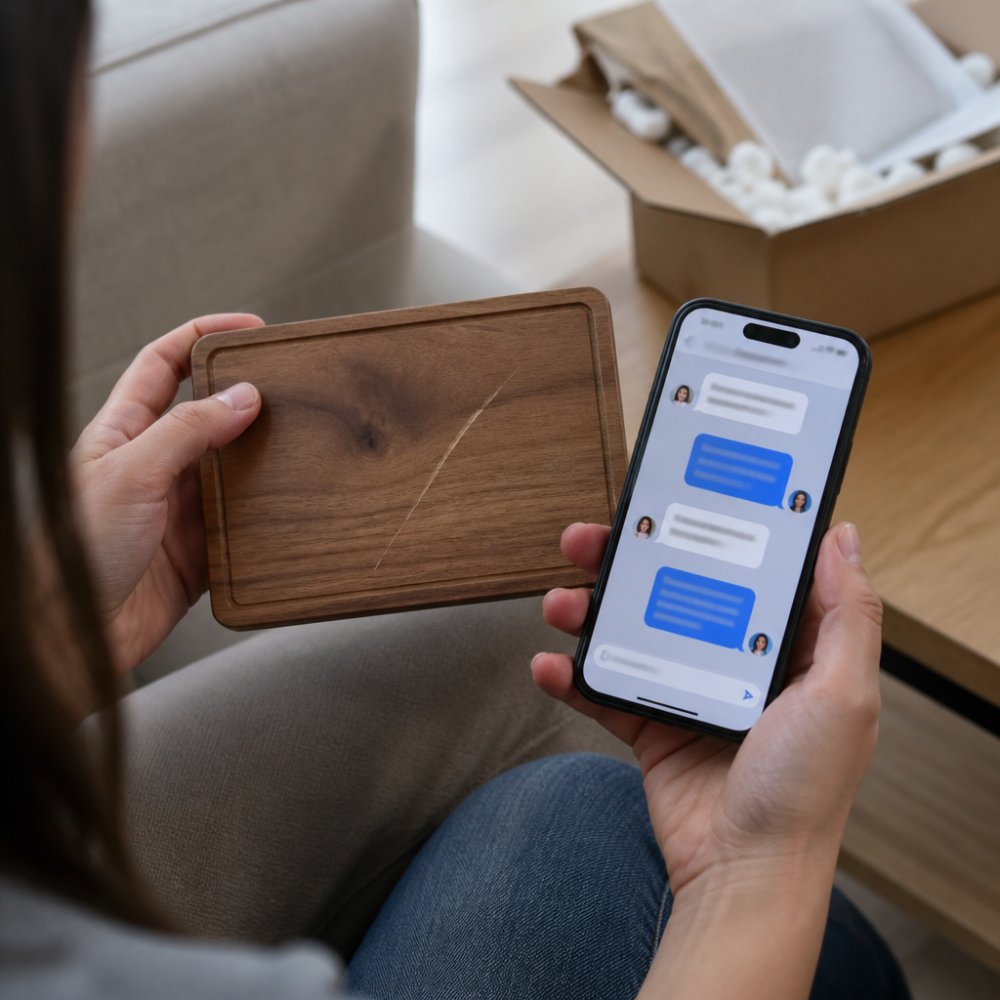
Faulty or damaged items are always eligible for a remedy, regardless of the personalisation exemption. If an engraved keyring arrives cracked, or a custom-printed cushion has a torn seam, the non-refundable rule does not apply.
Report the damage as soon as you notice it. Most policies ask for photographs of the item and the packaging, because this supports the business's own claim against the courier. Keep the original packaging until the issue is resolved.
Errors Made by the Seller
Errors made by the seller, such as a misspelled name or a photograph printed upside down, are the clearest case for a full refund or free replacement. The item does not match the agreed specification, so the contract has not been fulfilled correctly.
This is where a good submission workflow pays off for both sides. When the customer approves a digital proof before production, the agreed specification is documented, which makes it easy to tell a seller error apart from a customer change of mind.
How to Report a Defect in a Custom Product
To report a defect in a custom product, contact the seller as soon as possible with your order number, clear photographs of the fault, and a short description of what is wrong. Most reputable sellers respond within a few working days and will offer a replacement, repair, or refund.
The steps below are the ones that get results fastest.
- Check the item on arrival. Unpack and inspect within 48 hours so any transit damage is easy to attribute.
- Photograph everything. Capture the fault close up, plus the packaging and the shipping label.
- Locate your order number. It is usually in the confirmation email or on the packing slip.
- Write a short, factual message. State the order number, what is wrong, and what outcome you want.
- Attach the photos. This removes the need for a back-and-forth and speeds up the decision.
- Keep the item and packaging. Do not discard them until the case is closed.
- Follow up once. If you have no reply after a reasonable window, send a single polite follow-up.
Personalised Gift Delivery Time Expectations
Personalised gift delivery time expectations differ from standard retail because production happens after you order. A custom item is not picked from a shelf; it is made, checked, and then shipped. This means the clock starts when you approve the proof, not when you click 'buy'.
A realistic timeline usually has four stages, each with its own variables:
- Order and proof approval - You place the order and receive a digital proof. The time you take to approve it is the single biggest controllable delay. Most sellers allow 24-48 hours for proof approval before production begins, but if you sit on it for a week, everything shifts.
- Production - Engraving, printing, or cutting takes time. Production times vary by item; for example, a 3D acrylic LED lamp or a wooden plaque can take several working days. Production queues lengthen during peak seasons.
- Quality assurance - A quick check for defects or misalignment. This is usually same-day but can add a day if issues are found.
- Shipping - Transit time depends on the carrier and destination. Domestic deliveries typically take a few working days after dispatch; international orders can take longer.
Because production and shipping windows vary by item and destination, the honest answer is that delivery timing depends on the product, the season, and the delivery address. IL-ĦSIEB KOLLOX confirms current production and delivery windows at checkout, and our team can advise on timing before you commit. If you have a fixed date such as an anniversary or a graduation, order early and confirm the window first.
Seasonal demand is the other variable.
Restocking Fees and Consumer Rights for Custom Items
Restocking fees for custom items are a grey area, and it is worth being precise about them. A restocking fee is a charge deducted from a refund to cover the cost of returning an item to saleable stock. For genuinely personalised goods, that logic barely applies, because the item cannot be restocked at all. However, some businesses still charge a fee to deter frivolous returns or to cover administrative costs.
Custom Product Return Policy Template
Last updated: [Date]
Frequently Asked Questions
Can you return personalised items if they are damaged?
Yes. If a personalised item arrives damaged or faulty, you are entitled to a repair, replacement, or full refund under consumer rights law. Take clear photos of the damage and the packaging, then contact the seller within 14 days of delivery. The seller should cover return postage for faulty goods. Keep all original packaging until the issue is resolved, as it helps prove the item was damaged in transit rather than through misuse.
Why do most custom gift shops have a no-return policy?
Custom products are made to your exact specifications, including names, dates, photos, and colours. Once produced, they cannot be resold to another customer. This makes them non-refundable for change of mind. However, a no-return policy does not remove your consumer rights. If the item is faulty, damaged, or does not match what you ordered, you can still claim a refund or replacement regardless of the shop's standard policy.
What should I do if my custom-printed product arrives with a typo?
Check your order confirmation first. If the typo matches what you submitted, the error is yours and the seller is not obliged to refund. If the typo differs from your approved proof, it is a seller error. Report it within 14 days with photos of the product and your original order details. The seller should remake the item or issue a full refund, including any return postage costs.
How long does a custom order take from payment to delivery?
Personalised gift delivery time expectations vary by product and season. Most custom items need 3 to 7 working days for production before shipping. Standard delivery adds another few working days. During peak periods such as Christmas or wedding season, add extra time. Always order at least three weeks before your event date and confirm the seller's dispatch estimate in writing.